Thermal Evaporation
Thermal Evaporation
Crucible Heaters
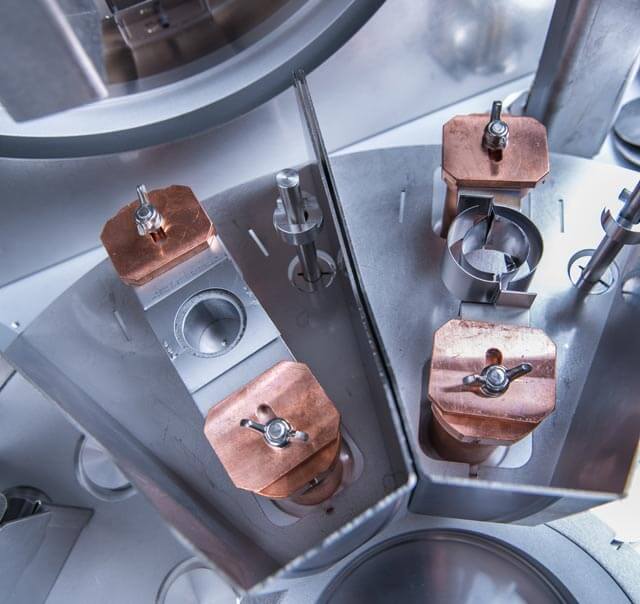
One strategy to getting more evaporation material into the chamber is to employ crucible heaters. In contrast, a resistive boat heats only from the bottom, and has a low capacity.
A thermal evaporation crucible holds more material and acts like a furnace, heating the material from all sides, allowing for thicker films as well as fewer pump-down cycles.
High capacity thermal evaporation sources are cylindrical containers fabricated from high temperature materials such as refractory metals, oxides, nitrides and graphite. These crucibles are encased by a resistive heater either as a coiled wire or a metallic sheet in form of a cylindrical basket. Together, the basket-shaped heater and cylindrical crucible assembly is referred to as crucible heater.
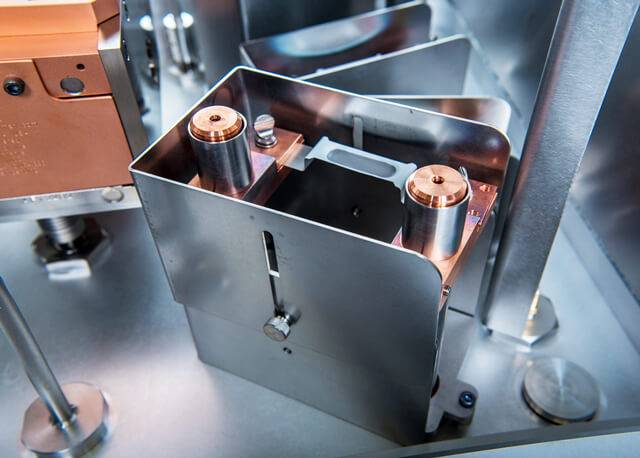
For crucible heaters to be an efficient source, they must be made of materials that can attain temperature of the evaporant material without having any significant vapor pressure of their own. Additionally, these crucibles should not react or alloy with the evaporant to cause any contamination. Their design allows heat to concentrate on the deposition materials uniformly. These heaters come with thermal shields which reduce the loss of radiative heat and keeps the components of the chamber at a adequately low temperature.

Dr. Peter Lomax
University of Edinburgh, UK
We have an Angstrom Engineering sputter platform, as well as an electron beam evaporation tool. The software has made both systems, which are used for a wide range of materials, simple to use. Furthermore, the ability for the Angstrom team to remotely connect to the software and platform has been particularly useful. We have been very impressed with the level of communication from Angstrom Engineering, who have kept us informed at all stages of the design and delivery process, offering advice on facilities when needed. Service and support have also been excellent, with very rapid turnaround when ordering materials, which have arrived as quickly as our UK-based vendors.