Platforms
ALD One®
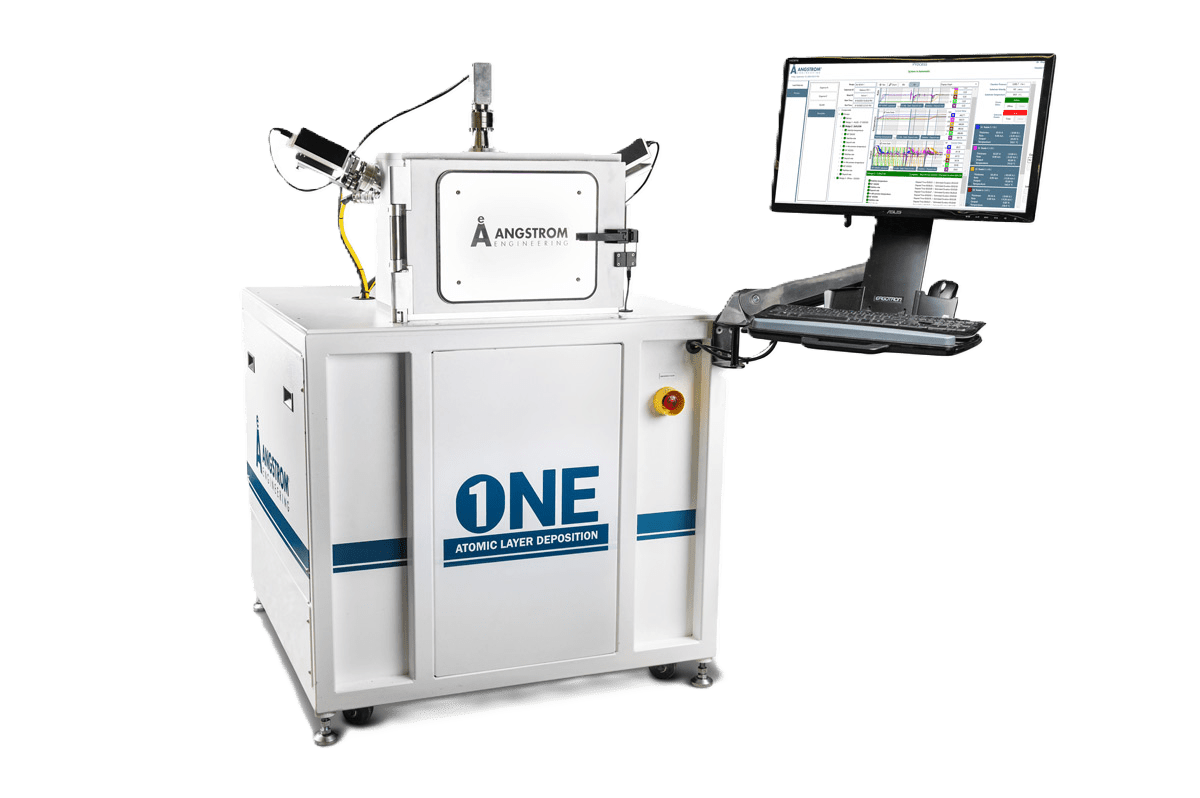
Our advanced atomic layer processing platform delivers excellent precision and process flexibility. This platform is built to push the boundaries of thin film engineering.
Whether used as a standalone platform or seamlessly integrated into a cluster system, our ALD solution is engineered for scalability, reliability, and real-time process optimization.
Features & Capabilities

Standalone & Cluster Integration
Expandable for high-throughput pilot or commercial-scale manufacturing.
Film Thickness Uniformity
±1% (1σ) for thermal ALD of Al₂O₃ on a
ø200 mm wafer.

Advanced In-Situ Monitoring
Real-time film growth tracking with ellipsometry & quartz crystal monitoring.

Substrate Compatibility
Up to Ø300 mm wafers or 210 mm × 210 mm (M12/G12) solar wafers.
Glovebox Integration
Controlled environment for sensitive materials.
Hollow Cathode Design
Plasma Source
Clean, oxygen-free nitride processes.
Process Control & Stability:
Differential pressure management between reactor and outer chamber for contamination-free processing.
Partnering with Angstrom Engineering®

Partnering with us means gaining access to a team of top-tier engineers and scientists, ensuring expert collaboration, rapid problem-solving, and tailored system optimization. Our commitment to innovation empowers researchers to achieve breakthrough advancements in thin film technology.
ALD In The Field
"Working with Angstrom Engineering® has been a great experience. The ALD reactor is easy to use, and the software is intuitive and working excellently. I’ve found it nice that this is a company where you deal with people throughout the organization, including the very top. Throughout our collaboration, business never got in the way of science and facts."
David Emslie,
McMaster University

Advanced Process Control Software
- PC/PLC-controlled recipes for single, batch, or automated processes.
- Advanced data logging and process tracking ensure consistent and repeatable processes.
- The central control station manages each module and schedules the processes in each chamber.
- Independent control of multiple chambers (if applicable).
- Complex recipes can be created and modified easily.
- Automatic PID control loop tuning significantly reduces process development time.

Learn more about Aeres®.
Why ATOMIC lAYER PROCESSING
Atomic Layer Deposition (ALD) is a sophisticated thin-film deposition technique that achieves excellent precision and uniformity through sequential, self-limiting surface reactions.
In this process, precursor gases are introduced into a reaction chamber in alternating pulses, each followed by an inert purge to prevent gas-phase interactions. This controlled, stepwise approach ensures that film growth is dictated solely by surface chemistry, enabling atomic-scale accuracy in thickness control.

Advantages
✔ Ability to produce exceptionally conformal coatings, even on substrates with intricate geometries, high aspect ratios, or porous structures.
✔ Achieve uniform coverage on complex surfaces.
✔ Operates at relatively low temperatures.
✔ Compatible with heat-sensitive materials while maintaining superior film quality and stoichiometric control.
✔ Supports a vast array of materials, including oxides, nitrides, sulfides, and metals, offering versatility in material engineering.
✔ Enables the deposition of both insulating and conductive films.
With its precision, repeatability, and ability to engineer ultra-thin films with atomic-scale accuracy, ALD stands as a cornerstone technology for next-generation nanotechnology, catalysis, and high-performance coatings.
ALD Processes, Precursors, & Related Materials
A wide range of films may be deposited using ALD, including many technologically important insulators, semiconductors, and metals. The following ALD Database is a curated collection of atomic layer deposition (ALD) processes, precursors, and related materials.
Hosted by Atomic Limits, the database helps users identify suitable ALD precursors and process parameters for various applications in nanotechnology, semiconductors, and thin-film coatings.

This work is licensed under a Creative Commons Attribution 4.0 International License.
If you want to refer to this database, you can use the DOI: 10.6100/alddatabase
ALD ONE® FAQ
What is the ALD ONE®?
The ALD ONE® is an atomic layer deposition (ALD) system designed and built by Angstrom Engineering® in Cambridge, Ontario, Canada. It supports both thermal ALD and plasma-enhanced ALD (PEALD). It is available as a standalone configuration or as a fully integrated module in a multi-chamber cluster system.
Does the ALD ONE® support plasma-enhanced ALD (PEALD)?
Yes. The ALD ONE® uses a hollow cathode plasma source. This source is suited to clean, oxygen-free nitride processes.
What film thickness uniformity does the ALD ONE® achieve?
The ALD ONE® achieves < ±1% (1σ) film thickness uniformity for thermal ALD of Al₂O₃ on a ø200 mm wafer.
What substrate sizes does the ALD ONE® accept?
The ALD ONE® is available in two configurations – a platform for up to ø200 mm wafers and a large-scale platform that accepts wafers up to ø300 mm and square solar wafers up to 210 mm × 210 mm (M12/G12 format).
What materials can be deposited with the ALD ONE®?
The ALD ONE® is a versatile atomic layer deposition (ALD) system designed for the deposition and development of a wide range of thin-film materials, including metal oxides, metal nitrides, sulfides, and metals. Demonstrated processes include Al₂O₃ (aluminum oxide), TiO₂ (titanium dioxide), SiO₂ (silicon dioxide), SnO₂ (tin oxide), TiN (titanium nitride), and AlN (aluminum nitride).
Its flexible precursor delivery and configurable thermal, plasma, and reactant capabilities allow researchers to develop additional ALD materials and chemistries based on their application requirements. Compatibility ultimately depends on factors such as precursor availability, reaction chemistry, substrate requirements, and the desired process conditions.
Does the ALD ONE® have in-situ process monitoring?
Yes. The ALD ONE® tracks film growth in real time with in-situ ellipsometry and a quartz crystal monitor (QCM).
Can the ALD ONE® be integrated with a glovebox?
Yes. The ALD ONE® can be seamlessly integrated with an inert-atmosphere glovebox, enabling sensitive substrates and materials to be transferred, processed, and handled without exposure to ambient air or moisture. This makes the platform particularly well suited for air- and moisture-sensitive applications, including perovskites, OLEDs, and other advanced materials where maintaining a controlled environment is critical to preserving material quality and device performance.
Can the ALD ONE® be combined with PVD in a cluster tool?
Yes. The ALD ONE® is designed for integration into Angstrom Engineering® multi-process cluster platforms, allowing ALD to be combined with PVD technologies such as sputtering, thermal evaporation, and electron-beam evaporation.
This creates a powerful platform for researchers developing multilayer thin films and advanced material interfaces, allowing substrates to transition between ALD and PVD processes without breaking the controlled vacuum environment. The result is greater flexibility for developing complex material stacks while reducing atmospheric exposure, contamination, and unwanted oxidation between deposition steps.
From advanced R&D and process development to automated pilot-scale production, an integrated ALD/PVD cluster system can be configured around the customer's materials, process sequence, substrate handling, and throughput requirements.
How does the ALD ONE® prevent contamination?
The ALD ONE® incorporates multiple levels of contamination control. Its high-vacuum-capable ALD reactor is housed within an independently pressure-controlled outer vacuum chamber, creating a unique dual-chamber architecture that enables precise management of process pressure, pressure gradients, and gas-flow dynamics.
Each precursor also uses an independent delivery path with no crossflow between precursor lines, helping prevent cross-contamination, condensation, and unwanted precursor reactions. Together, these features provide a clean, controlled process environment for repeatable ALD deposition and advanced materials development.
What software controls the ALD ONE®?
The ALD ONE® is powered by Angstrom Engineering's Aeres® PC/PLC process control software, providing intuitive recipe creation and automation, comprehensive data logging and process tracking, multi-chamber control, and automatic PID tuning for precise, repeatable processing.
What is the ALD ONE® used for?
The ALD ONE® is designed for thin-film research, process development, and device fabrication across a wide range of applications, including semiconductors and microelectronics, quantum technologies, display and photovoltaic, optical and photonic devices, energy storage, sensors and MEMS, and advanced materials research.
Its flexible configuration supports the development of ultrathin films, conformal coatings, dielectric and barrier layers, conductive films, passivation layers, and complex multilayer structures, with precise control over film thickness and interfaces.
What substrate temperature range does the ALD ONE® support?
The ALD ONE® is capable of substrate heating to up to 500 °C.
The system can accommodate up to a total of eight (8) precursor lines – with up to four (4) heated precursors (bubbler or vapour draw precursor bottles). All precursor lines are heated up to 200 °C. The reactor itself is heated to 300 °C.
Who manufactures the ALD ONE®?
Angstrom Engineering Inc. designs, builds and supports the ALD ONE® at its facility in Cambridge, Ontario, Canada. The company has made thin film deposition systems since 1992. Angstrom Engineering® is not affiliated with Angstrom-Dep or Angstrom Thin Film Technologies.